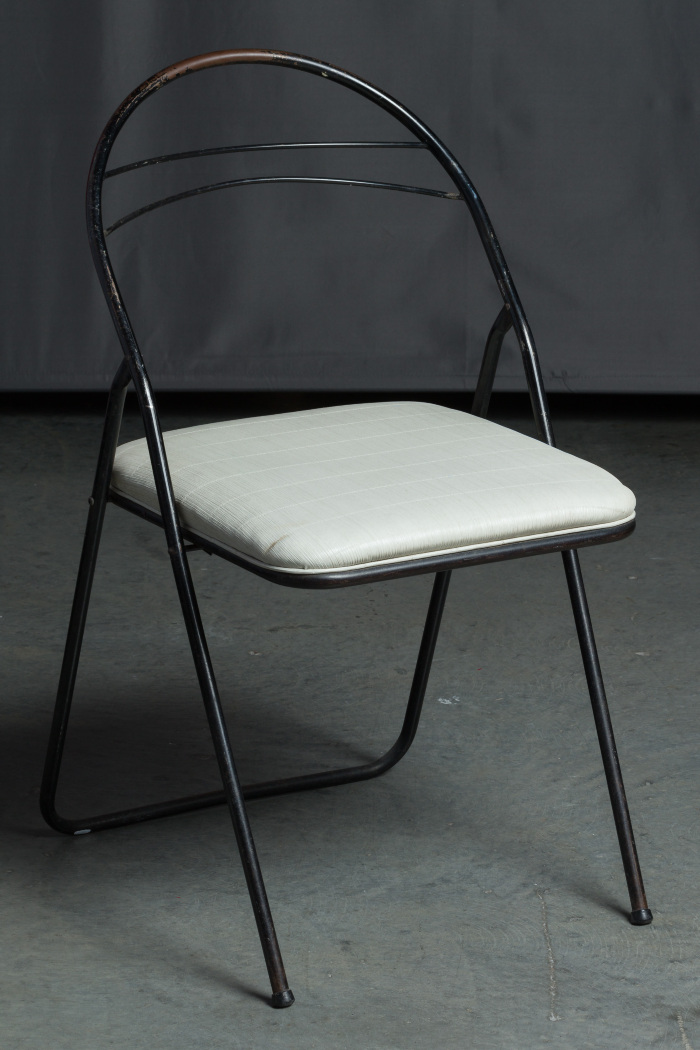
"The sculptor Julien Hébert represents one of the best examples of the successful influence of industrial design and art. He designed graceful folding furniture, became an influential teacher who trained a new generation of designers and used his knowledge of aluminum manufacturing techniques to enhance his work as a sculptor.
Hébert studied fine art at the École des Beaux-Arts in Montreal, graduating in 1941. Three years later, he earned a master's degree in philosophy from the Université de Montréal. Between 1947 and 1948, he studied sculpting in the Paris atelier of Ossip Zadkine, then returned to Montreal to teach fine art at his alma mater.
In the early fifties, Hébert designed lightweight metal furniture for Siegmund-Werner (under the Sun-Lite Outdoor Furniture brand name) that won five NIDC awards and was produced well into the sixties. Hébert claimed he knew a hundred ways to fold a chair.
Between 1951 and 1961, Hébert and a partner, Yves Groulx, produced wood and steel office desks, tables and commodes, under the name Grébert, Hébert received a grant to study industrial design at the Massachusetts Institute of Technology in 1953. Three years later he organized an exhibit, Good Design in Aluminum, at the National Gallery of Canada. In 1963, Hébert designed trapezoid school desks for the Montreal manufacturer Paul Dumont.
Between 1956 and 1966, he taught design at the École du Meuble (later the Institut des arts appliqués), where he led the drive to bring professional design techniques to Quebec's craft-oriented manufacturing industry. A decade later, he founded the faculty of industrial design at the Université de Montréal and trained such well-known designers as Michel Dallaire, Albert Leclerc and Marcel Girard.
In 1967 Hébert and his former pupil Girard designed 'La Ronde,' the widely known logo for Expo 67. This led to a commission to manage the design of both the Canadian and Quebec pavilions at the Osaka, in aluminum grace the foyer in the Place des Arts in Montreal (1963) and the Opera Hall ceiling in the National Arts Centre in Ottawa (1966)."