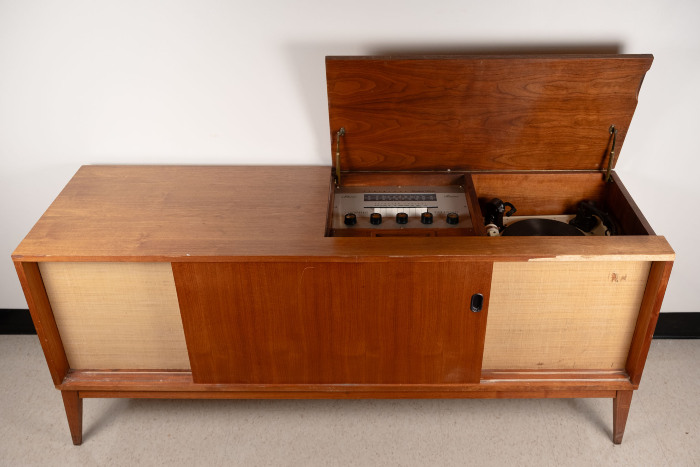
Related Object: Entertainment Cabinet
Clairtone Sound Corporation
Organization
Identifier
CU.ENT.00445
Display date
July 2 1958-1974
(activity)
History
"Clairtone Sound Corporation was launched in 1958 with $6,000. The intent was to become an export market leader in top-of-the-line stereos and televisions. During its heyday, the company contracted a Who’s Who of Canadian designers: Carl Dair, Frank Davies, Al Faux, Burton Kramer and Hugh Spencer. To achieve its goal, Clairtone employed innovative design, technology and marketing—factors some commentators claim led to its very public downfall.
Initially, the company imported Braun radios, imprinting them with the Clairtone logo. The founders, Peter Munk and David Gilmour, then launched a plan to capture the high-end stereo market in North America and Europe by housing top-notch electronics in modern-style teak and rosewood cabinetry. Its first break through was with Princess, a Scandinavian-style stereo cabinet designed by Gilmour, which won an NIDC award. Encouraged, the partners hired Hugh Spencer to create the groundbreaking Project G stereo, which became an icon of the swinging sixties.
The stereo was launched with an equally innovative campaign spearheaded by the former political strategist Dalton Camp. Foreshadowing present-day marketing campaigns, the program involved product endorsement by contemporary celebrities like Frank Sinatra, Tuesday Weld and Dizzy Gillespie, and the stereo was displayed in advertisements in Life, Vogue and The New Yorker—all firsts for a consumer electronics company. The renowned photographer Irving Penn photographed the stereo, and brochures featured the acclaimed jazz pianist Oscar Peterson. It was sold in department stores such as Bloomingdale's and Macy’s in New York and Selfridges in London, England.
Despite the high visibility of the G lineup—which included a tabletop design (G3)—Clairtone relied on traditional stereo cabinets (with names like Countess and Duchess) to achieve its sales volume. In 1965 Clairtone accepted provincial tax incentives and subsidies to relocate to Stellarton, Nova Scotia. A year later, it launched five models of colour television, one being the GTV, with traditional as well as Pop styling. Consumers weren’t ready to upgrade to colour, and the company foundered. This circumstance, combined with a disastrous foray into auto parts assembly, forced Munk and Gilmour out of the firm, and the plant was closed in the early seventies. By 1974 the company’s assets were liquidated and a competitor, Electrohome, briefly took over the plant. Munk now heads the multinational real estate and mining conglomerates TrizecHahn Corporation and American Barrick Resources."
Initially, the company imported Braun radios, imprinting them with the Clairtone logo. The founders, Peter Munk and David Gilmour, then launched a plan to capture the high-end stereo market in North America and Europe by housing top-notch electronics in modern-style teak and rosewood cabinetry. Its first break through was with Princess, a Scandinavian-style stereo cabinet designed by Gilmour, which won an NIDC award. Encouraged, the partners hired Hugh Spencer to create the groundbreaking Project G stereo, which became an icon of the swinging sixties.
The stereo was launched with an equally innovative campaign spearheaded by the former political strategist Dalton Camp. Foreshadowing present-day marketing campaigns, the program involved product endorsement by contemporary celebrities like Frank Sinatra, Tuesday Weld and Dizzy Gillespie, and the stereo was displayed in advertisements in Life, Vogue and The New Yorker—all firsts for a consumer electronics company. The renowned photographer Irving Penn photographed the stereo, and brochures featured the acclaimed jazz pianist Oscar Peterson. It was sold in department stores such as Bloomingdale's and Macy’s in New York and Selfridges in London, England.
Despite the high visibility of the G lineup—which included a tabletop design (G3)—Clairtone relied on traditional stereo cabinets (with names like Countess and Duchess) to achieve its sales volume. In 1965 Clairtone accepted provincial tax incentives and subsidies to relocate to Stellarton, Nova Scotia. A year later, it launched five models of colour television, one being the GTV, with traditional as well as Pop styling. Consumers weren’t ready to upgrade to colour, and the company foundered. This circumstance, combined with a disastrous foray into auto parts assembly, forced Munk and Gilmour out of the firm, and the plant was closed in the early seventies. By 1974 the company’s assets were liquidated and a competitor, Electrohome, briefly took over the plant. Munk now heads the multinational real estate and mining conglomerates TrizecHahn Corporation and American Barrick Resources."
History Source
Design in Canada (2004), p. 233-34
Domicile
Canada